Industry news
Inside a Stress Relief Patch Private Label Manufacturer's Workshop
Industry news 2026-09-20 09:12:21 71 views admin
Project Background: A Wellness Brand With a Tight Launch Window
The project involved a wellness brand preparing its first private-label Relaxation Patch for an online retail channel. The buyer was planning an initial production run around our standard 30,000-piece MOQ and wanted to establish a realistic launch schedule before committing to packaging artwork and inventory.
The product concept was straightforward: a discreet, individually packaged patch intended for everyday relaxation and nighttime relaxation routines. The procurement challenge was less straightforward. The buyer needed a consistent aroma, comfortable skin contact, suitable individual packaging, and a retail presentation that could be reproduced across future batches.
The initial brief also contained several unresolved choices. The brand had not finalized its essential oil blend, patch dimensions, backing material, or number of retail units per carton. These variables affected sampling, material procurement, packaging dimensions, and the final quotation.
The project was therefore organized around one objective: establish an approved, reproducible Relaxation Patch specification before releasing the production order. Launch timing would be calculated from that approved specification rather than from the date of the first inquiry.
Core Requirements: What Had to Be Fixed Before Quotation
The buyer wanted the Relaxation Patch to feel discreet during ordinary daily use. The proposed product needed a flexible backing, a controlled herbal aroma, an adhesive system appropriate for its intended application, and an individual pouch that would fit the planned retail carton.
As the stress relief patch private label manufacturer, our first task was to separate the buyer's preferences from specifications that could be checked during sampling and production. A description such as "soft material" was insufficient for purchasing. The backing material, patch dimensions, adhesive configuration, and intended contact conditions had to be documented.
The aroma requirement needed similar attention. The buyer initially requested a stronger fragrance, but intensity alone was not a complete formulation specification. The essential oil composition, fragrance consistency, material compatibility, and applicable ingredient documentation also required review.
Packaging presented another constraint. The buyer's designer had prepared a carton concept before the individual pouch dimensions were confirmed. Printing at that stage could have created a mismatch between the finished product and the retail box.
We held the artwork at the draft stage and moved the project into a controlled sampling process.
Our Solution: One Approved Configuration Before Production
The development team proposed a single primary Relaxation Patch configuration for the initial production run. Additional fragrance or packaging variations could be evaluated later, once the first specification had been approved and the brand had a clearer basis for repeat purchasing.
The sample brief covered the patch dimensions, backing material, adhesive system, essential oil formulation, individual pouch construction, and retail pack quantity. We also requested the intended sales-market information so that product classification, ingredient documentation, labeling, and marketing language could be reviewed against the relevant requirements.
A typical custom sampling window is 7–14 days after the technical brief is confirmed. This is a planning range rather than a guaranteed completion date; formulation revisions, material availability, and additional testing can extend development.
The buyer's sample review focused on observable product characteristics: aroma intensity, flexibility, appearance, adhesive behavior, and pouch presentation. Feedback was recorded against the same specification rather than through informal comparisons between unrelated samples.
Once the revised sample was accepted, it became the reference for packaging development, production documentation, and agreed quality checks.
Decision One: Keep the Initial Product Range Narrow
The buyer originally considered launching several aroma variations at the same time. That would have divided the first purchase across different formulations, packaging materials, and artwork files.
We reviewed the implications against the planned production quantity. Our standard MOQ for this type of project starts at approximately 30,000 patches, subject to the final formulation and packaging configuration. Splitting that quantity into multiple versions could introduce separate material minimums, additional setup work, and more complex inventory management.
The buyer chose to prioritize one primary formulation for the initial production plan. The decision reduced the number of samples requiring approval and allowed the packaging team to work from a single finished-product specification.
This did not establish that one aroma would outperform another in the retail market. It simply limited the number of variables that had to be controlled before the first production release.
Decision Two: Approve the Pouch Before the Carton
The packaging team identified a dimensional risk in the buyer's original artwork. The retail carton had been designed around an estimated individual pouch size rather than a finished sample.
We recommended confirming the patch dimensions and pouch construction first. The individual pouch needed to accommodate the patch, its protective materials, and the required sealing area. Its final dimensions would then determine the retail carton layout and packing arrangement.
The buyer revised the packaging workflow accordingly. The approved sample informed the pouch specification, and the confirmed pouch dimensions informed the outer carton design.
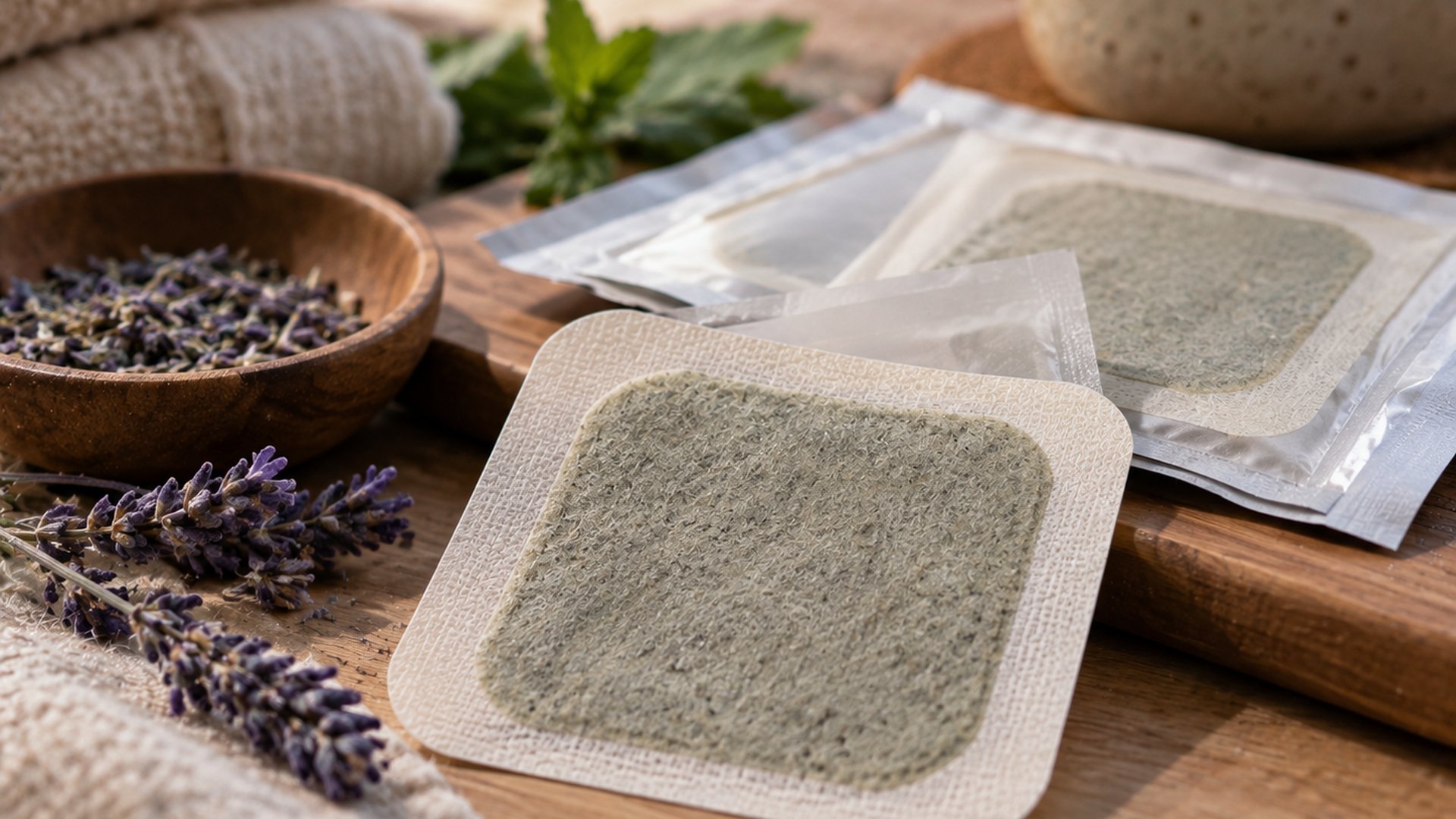
The artwork review also covered the intended product positioning. The Relaxation Patch was presented as an everyday wellness product for relaxation routines, without unsupported medical or guaranteed-outcome claims. Final wording, ingredient declarations, instructions, and precautions remained subject to the applicable market and product-classification requirements.
Artwork approval was treated as a production prerequisite, not a task to complete after materials had been ordered.
Decision Three: Define Acceptance Checks Before Scheduling the Batch
The final decision concerned quality control. The buyer initially described the desired product as "consistent with the approved sample," but that statement needed to be translated into practical inspection requirements.
The production specification identified the agreed patch dimensions, material construction, appearance, packaging format, and relevant adhesive and pouch-integrity checks. Aroma consistency would be assessed against the approved formulation and agreed evaluation method, with any necessary stability or compatibility work determined by the final materials and intended use.
The manufacturer also needed batch identification, material traceability, and finished-product records appropriate to the product and applicable requirements.
These checks were agreed before the production schedule was finalized. That gave the buyer and factory a shared basis for reviewing deviations rather than negotiating acceptance criteria after the goods had already been made.
Results and Numbers: What the Project Established
The project produced an approved development specification and a defined route toward the first production order. The documented outcome was a narrower product scope, coordinated packaging dimensions, and clearer acceptance requirements. It would be inaccurate to present these process improvements as proof of retail sales performance or to claim a completed shipment without confirmed production records.
The principal planning figures and decisions were:
| Project item | Agreed planning basis |
|---|---|
| Product | Relaxation Patch |
| Buyer | Private-label wellness brand |
| Initial production quantity | Approximately 30,000 patches, subject to final specifications |
| Custom sampling | Typically 7–14 days after brief confirmation |
| Initial product range | One primary formulation and packaging configuration |
| Packaging sequence | Approved patch → individual pouch → retail carton |
| Production release | After sample, specifications, artwork, and acceptance requirements are approved |
The MOQ and sampling window are manufacturing planning parameters, not fabricated project performance figures. The final unit price, production lead time, testing scope, and shipment date depend on the approved materials, packaging, order terms, and production schedule.
For the buyer, the immediate result was a purchase plan built around a defined product rather than a collection of unresolved preferences.
The Lesson: Reduce Uncertainty Before Increasing Volume
This project illustrates a recurring issue in private-label patch sourcing: buyers may seek a final price and delivery date while the formulation, materials, and packaging are still changing.
The useful lesson is to establish the product specification in the same order that production depends on it. Confirm the intended use and target market, select the formulation and patch construction, evaluate the physical sample, approve the individual packaging, and then finalize the retail artwork and production acceptance criteria.
A stress relief patch private label manufacturer can provide more reliable commercial and scheduling information when these decisions are documented. The buyer can also assess the complete procurement cost, including materials, packaging, testing, and production requirements, instead of comparing an isolated price per patch.
For a first Relaxation Patch order, keeping the initial configuration manageable creates a clearer reference for quality checks and future repeat production. Additional variations can then be developed against an established specification rather than introduced while the first batch is still being defined.
CATEGORIES
LATEST NEWS
- Sinew-Bone Pain-Bi Patch Private Label Manufacturer Supply Agreements
- What Hand Mask Custom Packaging Supplier Quotes Overlook
- Kids Herbal Foot Patch Contract Manufacturer: Safety Specifications First
- Mugwort Steam Eye Mask Private Label Manufacturer Readiness Check
- Mugwort Essential Oil Custom Formula Supplier: Formulation Approval Milestones
CONTACT US
QQ: 396269538
Phone: 17796669065
Tel: 17796669065
Email: 396269538
Add: Room 001, 1st Floor, Building 1, Zhengzhou Hangmei International Smart City, Intersection of S102 and Nanquan Road, Xuedian Town, Xinzheng City, Zhengzhou, Henan Province, China