Industry news
What Hand Mask Custom Packaging Supplier Quotes Overlook
Industry news 2026-10-19 15:59:00 12 views admin
The Artwork Was Ready, but the Labels Were Not
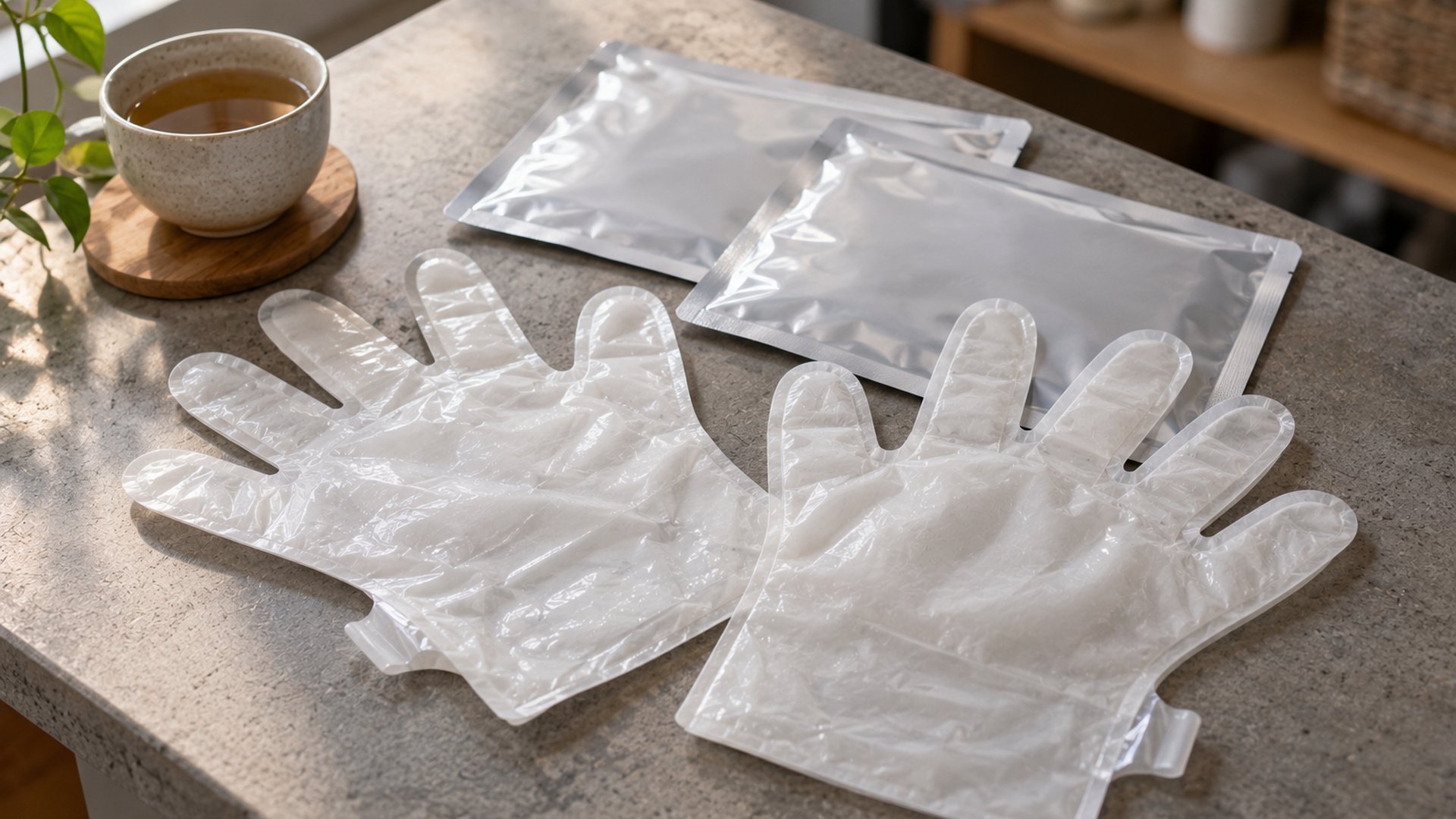
The importer had already approved the Hand Mask pouch design. The product was a moisturizing glove-style mask, individually packed for retail sale, with a simple skincare positioning. The artwork looked finished: product photograph, usage instructions, ingredient list, and a clean front panel. Then the purchasing team asked whether the same pouch could serve customers in the European Union, United States, Gulf countries, and Southeast Asia.
That question changed the packaging discussion. A hand mask custom packaging supplier can reproduce artwork accurately and still deliver packaging that cannot be sold legally in its intended market. The problem is usually buried in the small print: the responsible company's address, ingredient terminology, language requirements, or product claims.
Consider this as a representative importer scenario, rather than a documented customer order. The sensible manufacturing response would be to stop the printing approval and build four market-specific label reviews around one approved product formula.
The buyer would retain the same Hand Mask construction and primary pouch dimensions. Only the legally necessary artwork elements would change. That separation matters because packaging engineers should not be asked to solve regulatory questions by guessing which information belongs on the back panel.
Which Information Must Be Checked on Every Hand Mask Label?
The first correction is straightforward: there is no single universal cosmetic label that automatically satisfies all four markets. However, every version needs a common information file before artwork can be approved.
For a cosmetic Hand Mask, the buyer should establish the product identity, intended use, complete ingredient composition, net contents, manufacturer and responsible business details, batch identification, usage directions, necessary warnings, and applicable durability information. Which fields must appear directly on the retail pack depends on the destination's rules.
The ingredient list deserves special attention. A supplier's production formula may contain internal raw-material codes, trade names, and premixed solutions. Those entries cannot simply be pasted into consumer artwork.
For example, an internal formula sheet might identify a moisturizing blend under a supplier-specific commercial name. The finished cosmetic ingredient declaration instead needs the applicable recognized ingredient names, normally following the market's required naming convention and ordering rules.
The importer should request three controlled documents before design approval: the finalized formula composition, the proposed consumer ingredient declaration, and a market-by-market label checklist.
One practical distinction is often missed. Packaging artwork is not the same as product regulatory approval. Ingredient restrictions, product classification, safety substantiation, and any required notification or registration must also be addressed. A correctly printed pouch cannot compensate for a noncompliant formulation.
Why Did Four Markets Require Different Label Decisions?
The proposed Hand Mask was intended to be marketed as a cosmetic moisturizing product. That classification is important: adding therapeutic claims could change the applicable regulatory pathway.
The packaging team would need to review the following requirements separately.
| Market | Main label considerations | Common approval obstacle |
|---|---|---|
| European Union | EU responsible person, nominal content, batch reference, durability or PAO where applicable, precautions, product function, and INCI ingredient list | Missing responsible-person details or required local-language information |
| United States | Product identity, net quantity, business name and address, ingredient declaration, and applicable warnings; MoCRA obligations assessed separately | Incorrect ingredient terminology or incomplete business identification |
| Gulf markets | Country-specific Arabic requirements, importer details, ingredient information, and applicable GCC or national cosmetic rules | Assuming one English-only Gulf label is acceptable everywhere |
| Southeast Asia | ASEAN-aligned cosmetic labeling where applicable, local responsible business details, country-of-origin information, ingredients, batch and durability information | Treating ASEAN harmonization as identical language and notification rules across countries |
The EU review should begin with Regulation (EC) No 1223/2009 and the applicable national language rules. The United States requires review of FDA cosmetic labeling requirements and relevant Modernization of Cosmetics Regulation Act obligations.
For Gulf distribution, the buyer must identify the actual destination countries. Saudi Arabia and the UAE, for example, should not be treated as interchangeable simply because both participate in regional standards frameworks.
Southeast Asia requires the same discipline. The ASEAN Cosmetic Directive provides a shared framework, but implementation, notification processes, and language requirements remain country-specific.
The importer therefore needs a destination-country matrix, not four decorative flags on a generic artwork file.
Where Does Translation Quietly Break Compliance?
The buyer's biggest risk may be a translation that looks perfectly reasonable to a graphic designer.
Take the English phrase "moisturizing hand mask." In one market, the approved local wording may describe a cosmetic glove treatment. In another, a literal translation could imply a medical dressing or therapeutic product. The underlying formula has not changed, but the wording may create a different regulatory interpretation.
Ingredient names create another problem. The internationally recognized ingredient declaration should not be casually translated into everyday botanical names. The ingredient list must follow the naming and formatting rules of the destination market, while consumer instructions and warnings may need authorized local-language versions.
The artwork review should therefore separate three categories of text: regulated ingredient declarations, legally required consumer information, and optional marketing copy.

A translator can handle language, but a qualified regulatory reviewer must approve the compliance-sensitive meaning. That distinction becomes particularly important for Arabic labels and multilingual Southeast Asian packs.
The importer should also avoid relying on machine translation for warnings about intended skin contact, damaged packaging, or discontinuing use if irritation occurs. These instructions need accurate, understandable wording consistent with the approved product assessment.
A sensible approval process uses two independent reviews: linguistic accuracy and regulatory acceptability. The same person can perform both only if appropriately qualified.
For this Hand Mask project, the practical solution would be to keep the approved formula-linked ingredient declaration under document control and maintain separate language layers for each destination. Every change would receive a revision number, preventing an older translation from returning to the printing file.
How Should the Buyer Approve Artwork Before Printing?
Once the four regulatory reviews are complete, the factory still needs a disciplined pre-press release. This is where an apparently minor revision can become expensive: a designer replaces an address, shifts a warning into a fold, or exports an outdated ingredient panel.
The buyer should require a six-stage sign-off process.
Stage 1: Confirm classification. Record the Hand Mask's intended cosmetic function and approve the claim language for each destination. Any claim that changes the regulatory classification triggers another review.
Stage 2: Freeze the ingredient declaration. Match the artwork against the finalized formula and the applicable ingredient naming and ordering requirements. Changes to the formula reopen this approval.
Stage 3: Verify local business information. Check the responsible person, manufacturer, distributor, or importer details required in each market. Confirm that the addresses and contact information are current.
Stage 4: Approve translations. Have a qualified reviewer sign off on instructions, warnings, product function, and mandatory local-language statements. Keep the reviewed text alongside the artwork revision.
Stage 5: Inspect the physical proof. Print a full-size mock-up and examine legibility, contrast, seal-area interference, and the position of mandatory information. Review both the individual pouch and any retail carton.
Stage 6: Release the master file. Obtain written approval from the brand owner, regulatory reviewer, and packaging supplier before printing. Archive the approved PDF, revision history, and signed proof.
The outcome of this representative sourcing exercise is a clear manufacturing decision: retain one controlled Hand Mask specification, but release destination-specific packaging only after its own compliance approval.
For an importer comparing hand mask custom packaging supplier quotations, the meaningful question is whether regulatory artwork control is included in the service scope. Printing four language versions is straightforward. Preventing an incorrect version from reaching the market requires a documented approval process.



CATEGORIES
LATEST NEWS
- Sinew-Bone Pain-Bi Patch Private Label Manufacturer Supply Agreements
- What Hand Mask Custom Packaging Supplier Quotes Overlook
- Kids Herbal Foot Patch Contract Manufacturer: Safety Specifications First
- Mugwort Steam Eye Mask Private Label Manufacturer Readiness Check
- Mugwort Essential Oil Custom Formula Supplier: Formulation Approval Milestones
CONTACT US
QQ: 396269538
Phone: 17796669065
Tel: 17796669065
Email: 396269538
Add: Room 001, 1st Floor, Building 1, Zhengzhou Hangmei International Smart City, Intersection of S102 and Nanquan Road, Xuedian Town, Xinzheng City, Zhengzhou, Henan Province, China