Industry news
Sinew-Bone Pain-Bi Patch Private Label Manufacturer Supply Agreements
Industry news 2026-10-20 08:21:36 5 views admin
The RFQ Looked Fine Until We Opened the QC Requirements
The first thing I look for in a Sinew-Bone Pain-Bi Patch order is the inspection standard. Buyers usually specify the patch dimensions, backing material, herbal filling, and retail packaging. Then the purchase order says something vague like "good quality, no defects." That sentence is where arguments begin.
Consider a representative factory-floor scenario. An importer requests a private-label batch for a warming comfort product. The approved sample looks consistent, but the draft purchase order contains no measurable limits for filling weight, sealing defects, or damaged pouches. Production could proceed, yet nobody has agreed on what would justify rejecting the finished goods.
As a sinew-bone pain-bi patch private label manufacturer, we would stop the release process and ask the buyer to approve a written defect classification.
To be honest, a factory can make a visually attractive sample without proving that every finished carton will meet the same requirements. A useful inspection agreement must cover the product, the individual pouch, and the packed shipment.
The numbers below are illustrative specifications for planning an inspection. They are not records of an actual customer order or universal acceptance standards.
Five Defects That Deserve Separate Inspection Rules
We would start by separating defects according to their consequences. Treating a crooked patch and an open pouch as equivalent problems makes the inspection result meaningless.
1. Incorrect filling weight. Suppose the approved Sinew-Bone Pain-Bi Patch has a target filling weight of 4.0 g. A proposed tolerance of ±0.20 g creates an acceptable range of 3.80–4.20 g. The buyer must specify whether this measurement excludes the backing, adhesive, and release liner.
2. Uneven herbal filling. Material concentrated at one edge can make the patch feel bulky and create inconsistent appearance. Inspection should compare filling distribution against the approved reference and identify unacceptable empty areas or clumps.
3. Backing and adhesive defects. Wrinkles, exposed adhesive, lifting edges, or visible contamination should be classified according to severity. Any issue affecting intended skin contact requires closer assessment than a minor cosmetic irregularity.
4. Damaged individual pouches. Incomplete seals, punctures, and leakage can compromise the protective packaging. A confirmed loss of required package integrity should trigger product hold and investigation rather than routine cosmetic acceptance.
5. Incorrect identification or packing. Wrong batch identification, mixed variants, missing required information, and incorrect quantities can make an otherwise acceptable batch unsuitable for shipment.
Look, these five categories cannot all share the same tolerance. A slightly uneven edge may be a minor defect. An incorrect batch identity can undermine traceability.
That distinction needs to be written down before inspection begins.
How Many Patches Should the Buyer Actually Inspect?
AQL sounds complicated until someone explains what the inspector does.
Instead of checking every finished unit, the inspector selects a defined number of units from a clearly identified lot. The sample size depends on the lot quantity, inspection level, and sampling standard.
For illustration, consider a lot containing 12,000 finished patches, inspected under ISO 2859-1 general inspection level II using a normal, single-sampling plan.

That lot falls within the 10,001–35,000 range, producing sample-size code M and a sample of 315 units.
A possible commercial inspection arrangement is:
| Defect category | Proposed AQL | Acceptance / rejection count |
|---|---|---|
| Critical | 0 permitted | Accept 0; reject at 1 |
| Major | 1.0 | Accept 7; reject at 8 |
| Minor | 2.5 | Accept 14; reject at 15 |
The major and minor counts above correspond to the stated illustrative sampling plan. The critical-defect rule is a separately agreed zero-acceptance requirement, not a claim that AQL 0 is a standard sampling column.
These figures also require one important qualification: AQL is a sampling decision rule, not permission to manufacture defective products.
A lot accepted under AQL 2.5 does not mean that 2.5% defective products are automatically acceptable to the buyer. It means the observed sample result satisfies the agreed statistical acceptance plan.
We would also require the purchase order to identify how multiple defects on one unit are counted and whether individual defect classes are evaluated independently.
The factory should draw samples from different cartons and production intervals. Selecting 315 patches from the easiest carton to reach defeats the purpose.
For regulated products, mandatory safety, identity, and packaging-integrity requirements take precedence over any commercial AQL agreement.
Why Packing Inspection Catches Problems the Production Line Misses
The line inspector can measure patch weight and examine filling distribution before individual packaging. That is necessary, but it does not prove the finished goods are ready to ship.
I have seen how easily a good product can become a questionable shipment during the final handling stages. A pouch can be creased during transfer, a sealing jaw can collect residue, or a carton can contain the wrong quantity.
For the representative Sinew-Bone Pain-Bi Patch specification, we would propose checking package integrity at the finished-pouch stage using a validated method.
An illustrative monitoring plan might test 2% of finished pouches from defined production intervals, subject to a minimum sample quantity agreed in the inspection procedure. That 2% is a proposed process-monitoring rate, not a substitute for validated seal testing or a regulatory requirement.
If a test identifies an open seal, the factory should investigate the affected production interval. Simply discarding the failed pouch and continuing would leave the cause unresolved.
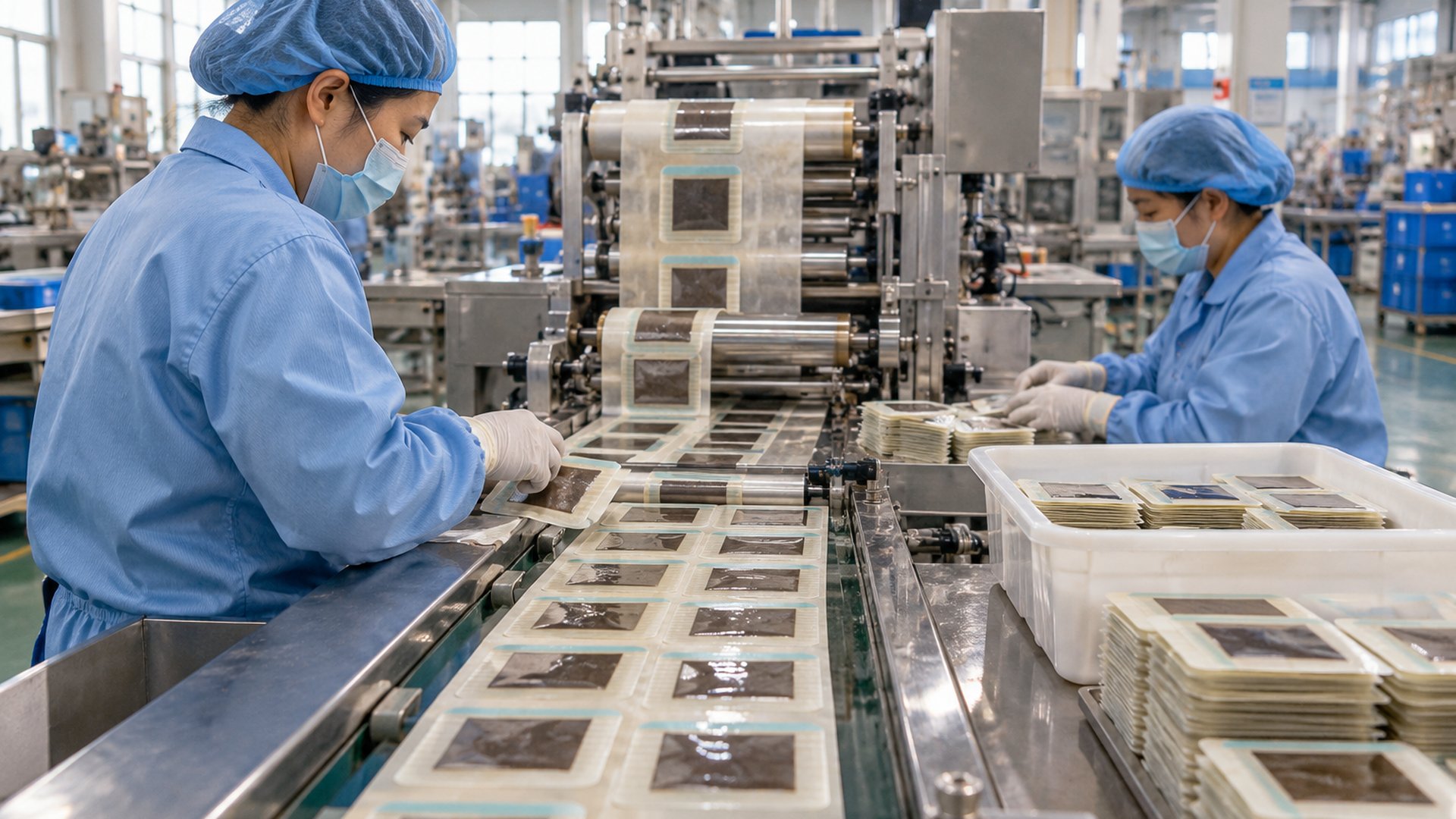
The packing inspection must also verify the link between the individual pouch, retail carton, and master carton.
A patch can meet every physical specification while its outer carton carries the wrong lot reference. That error matters because the importer may need to identify affected goods later.
We would therefore check finished retail units, not just loose patches from the conveyor.
The final inspection record should include the quantity presented, sampling method, defect counts, package-integrity results, and disposition of any nonconforming goods.
The One-Page Inspection Checklist We Would Attach to the PO
A useful quality agreement does not need twenty pages of vague promises. It needs one operational checklist supported by approved specifications and test procedures.
For a first Sinew-Bone Pain-Bi Patch order, we would use the following release sequence.
Before inspection: Confirm the lot boundary, approved product specification, physical reference sample, and current artwork revision. Verify that the sampling plan is applicable to the finished lot quantity.
Product inspection: Check appearance, filling distribution, adhesive condition, and individual filling weight. Record actual measurements rather than writing only "pass."
Defect classification: Separate critical, major, and minor findings. Apply the agreed acceptance and rejection counts without reclassifying defects after results are known.
Packaging inspection: Examine pouch integrity, seal appearance, and packaging damage. Complete the agreed seal tests and document failures.
Identification inspection: Match lot references and required product information across the pouch, retail carton, and shipping carton. Verify packed quantities.
Release decision: Record the inspected quantity, defect counts, test results, corrective actions, and final approval authority.
The important part is what happens after a failed inspection.
We would not automatically release the goods because the supplier promises to improve the next batch. The affected lot should remain on hold until the nonconformity is investigated and an agreed corrective action is completed.
Reworked goods need an appropriate reinspection plan. If the problem concerns package integrity, reinspection alone may be insufficient without evidence that the sealing process is controlled.
For the buyer, this creates a clear decision trail. For the manufacturer, it prevents disputes based on changing expectations.
That is the real value of putting AQL numbers and defect definitions into a supply agreement: both parties know what must be inspected, what counts as failure, and who can authorize shipment.
A lower quotation cannot compensate for an inspection standard that nobody can enforce.

CATEGORIES
LATEST NEWS
- Sinew-Bone Pain-Bi Patch Private Label Manufacturer Supply Agreements
- What Hand Mask Custom Packaging Supplier Quotes Overlook
- Kids Herbal Foot Patch Contract Manufacturer: Safety Specifications First
- Mugwort Steam Eye Mask Private Label Manufacturer Readiness Check
- Mugwort Essential Oil Custom Formula Supplier: Formulation Approval Milestones
CONTACT US
QQ: 396269538
Phone: 17796669065
Tel: 17796669065
Email: 396269538
Add: Room 001, 1st Floor, Building 1, Zhengzhou Hangmei International Smart City, Intersection of S102 and Nanquan Road, Xuedian Town, Xinzheng City, Zhengzhou, Henan Province, China