Industry news
Cost Planning for Mugwort Warming Patch for Global Brands
Industry news 2026-09-11 10:42:03 85 views admin
The Options Look Similar, but the Differences Cost Real Money
The options look similar but the differences cost real money. When buyers compare a mugwort warming patch factory in China, the first quotations can make several suppliers appear almost interchangeable. A rectangular or oval Mugwort Warming Patch, an individual pouch, a printed box, and a similar MOQ can still hide very different manufacturing routes. The differences usually sit in formula flexibility, patch construction, packaging responsibility, testing, documentation, and how much development work the factory will actually handle.
Before comparing unit prices, put the suppliers into practical categories. The table below is a useful starting point.
| Buying Factor | Stock-Formula Factory | Custom-Formula OEM Factory | Full-Service OEM/ODM Factory |
|---|---|---|---|
| Formula | Existing formula, limited changes | Mugwort formula can be adjusted | Formula, patch structure and positioning can be developed together |
| Typical MOQ | Often 10,000–30,000 pieces | Commonly around 30,000+ pieces | Commonly 30,000+ pieces, depending on customization |
| Sampling | Fastest when using stock specifications | Usually 7–14 days for normal development | Often 7–21 days when several components require confirmation |
| Patch material | Mostly existing options | Multiple substrate/adhesive options | Broader material and construction development |
| Packaging | Basic private label | Custom pouch and retail box | Pouch, box, carton and channel-oriented packaging support |
| Cost level | Usually lower | Middle | Usually higher at development stage |
| Buyer workload | Higher | Moderate | Lower |
| Best fit | Market testing and simple private label | Established specification with meaningful differentiation | Brands building a more customized product line |
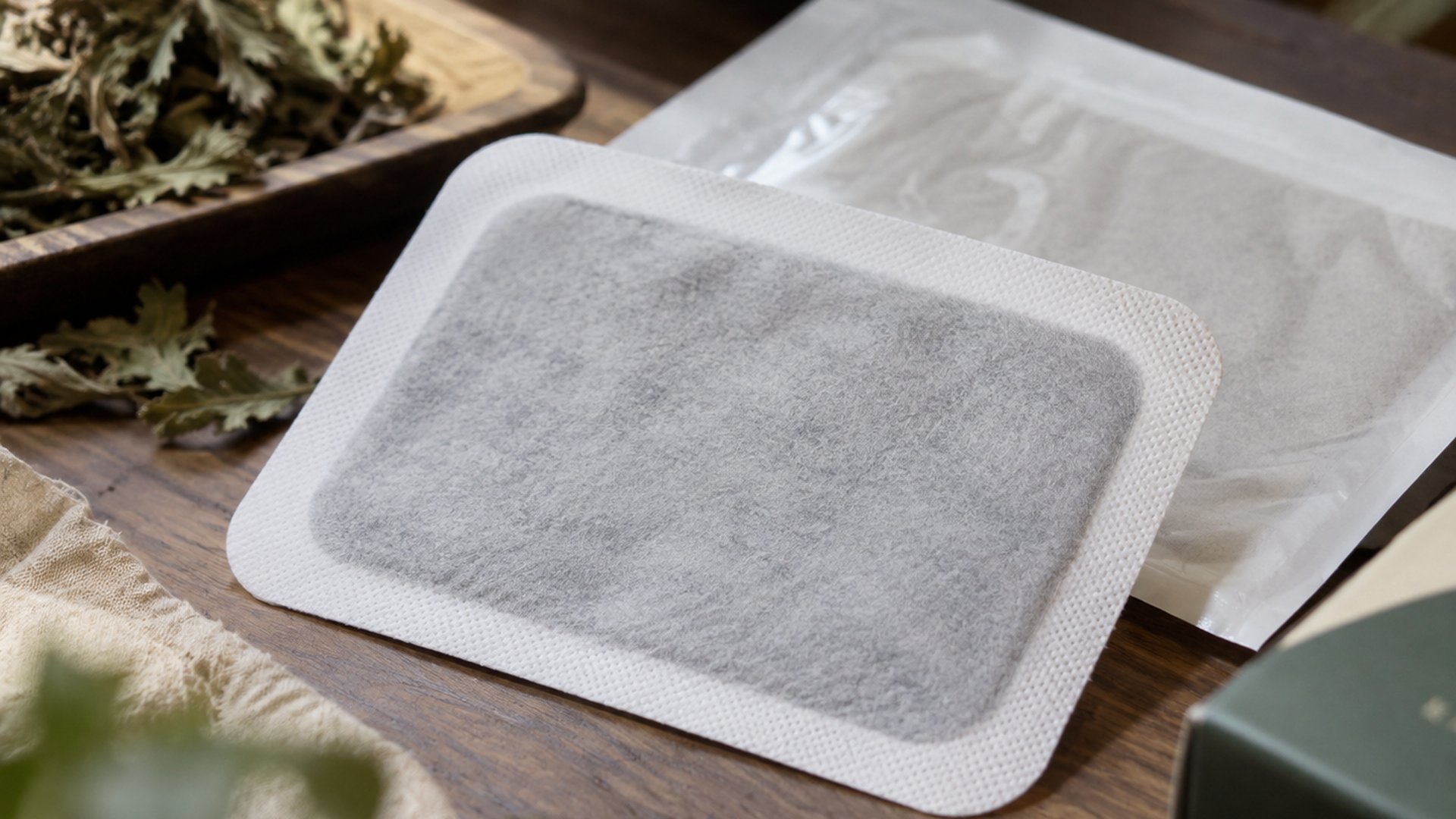
These are sourcing ranges rather than guaranteed terms. MOQ and sampling time should always be confirmed against the final formula, dimensions, materials, packaging and number of SKUs.
Stock Formula: Lower Entry Cost, Less Room to Change
A stock-formula supplier makes sense when speed and budget matter more than product differentiation. The buyer normally selects an existing Mugwort Warming Patch specification, chooses from available sizes or substrates, and applies customized packaging. This keeps development work relatively light and can reduce sampling complexity.
The trade-off is control. A low quotation may assume the factory's standard patch dimensions, existing mugwort-based formulation, regular pouch material and established production process. Asking for a different adhesive feel, substrate, mugwort ingredient profile, patch thickness or pouch structure can quickly move the project outside that original quotation.
For a buyer testing a new e-commerce market, this route can be sensible. Keep the SKU count low, avoid unnecessary structural changes and spend more attention on packaging execution and supply consistency. The mistake is expecting stock-formula economics while requesting a heavily customized product.
Custom Formula: Pay More Where Consumers Can Notice It
The middle option is usually more interesting for brands that already understand their target customer. A custom-formula OEM can adjust the Mugwort Warming Patch around agreed parameters such as ingredient composition, substrate, adhesive characteristics, dimensions and intended warming comfort positioning. The buyer gets more differentiation without necessarily commissioning an entirely new product architecture.
This is where sampling deserves budget. A 7–14 day sampling window is a reasonable planning range for many conventional projects, although additional revisions can extend it. Buyers should evaluate the complete sample rather than approving ingredients on paper. Patch flexibility, adhesion, removal, material feel, aroma if used, pouch opening and stability after packaging all affect the finished product.
Custom development also makes quotation comparison harder. Two factories may both quote a "custom Mugwort Warming Patch," while one includes formula adjustment and several material choices and another is only modifying a stock formula. Ask exactly what has been customized before deciding which price is lower.
Full-Service OEM/ODM: More Coordination Included in the Price
A full-service mugwort warming patch factory in China becomes useful when the buyer wants one supplier to coordinate product development, individual pouches, retail boxes, master cartons and production documentation. This model generally costs more during development, but it can reduce the amount of coordination handled by the buyer.
The advantage becomes clearer with export projects. A patch cannot be developed independently from its packaging. Changing patch dimensions can affect pouch dimensions; changing pouch dimensions can alter box size; changing box size can affect master-carton loading and freight economics. A factory managing these elements together can catch compatibility problems earlier.

The downside is paying for services you may not need. If your brand already has a finalized formula, tested materials, finished dielines and an experienced packaging supplier, a full ODM package may add little value. Buy the manufacturing capability you actually need rather than automatically selecting the supplier offering the longest service list.
How to Decide Which Factory Model Fits Your Order
Start with what is already fixed. If only the brand artwork is ready and the product specification remains flexible, a stock-formula route can keep the first order manageable. If you know the patch size, material preferences, ingredient direction and desired user experience, custom OEM usually gives a better balance between differentiation and development cost. If the project still needs coordination from formula through export packaging, full-service OEM/ODM deserves closer consideration.
MOQ should be calculated at SKU level rather than only at total-order level. A 30,000-piece project sounds straightforward until it becomes three formulas, two sizes and three packaging designs. Material purchasing, printed pouches and cartons may each have their own economic quantities. Splitting volume too early can make a supposedly affordable order surprisingly expensive.
Send every shortlisted factory the same specification sheet. Include patch dimensions, substrate, formula direction, units per pouch or box, number of SKUs, target market, packaging requirements and estimated annual demand. Comparable inputs produce far more useful quotations.
Common Misreads When Comparing Chinese Patch Factories
The first misread is treating MOQ as a universal number. A factory may accept around 30,000 pieces for one standard specification but require different quantities when custom printed materials, unusual substrates or multiple formulas are involved. Always ask whether the stated MOQ applies per product, per formula, per fragrance, per packaging design or across the entire purchase.
The second is reading sample speed as manufacturing strength. Receiving a sample quickly is convenient, but the important question is whether the approved specification can be transferred consistently into production. Keep an approved reference sample and record formula version, dimensions, substrate, adhesive specification, pouch structure and packaging artwork.
The third is comparing certifications by logo count. Documentation should match the product, manufacturing scope and destination market. Buyers should request relevant documents and verify what they actually cover instead of assuming that a long row of certificates automatically makes one supplier suitable for every market.
The Better Choice Depends on What You Are Buying
There is no single factory model that fits every Mugwort Warming Patch project. For an early market test, I would lean toward a proven specification with limited customization and one or two packaging variants. It keeps the first MOQ easier to manage and gives the buyer real sales feedback before investing heavily in development.
For an established brand, custom OEM becomes more attractive because formula, material and construction differences can create a more identifiable product. Full-service OEM/ODM makes the most sense when packaging, production and export coordination would otherwise be divided among several vendors.
When evaluating a mugwort warming patch factory in China, compare the same finished specification rather than the headline unit price. Ask what the quotation includes, what triggers a new MOQ, how samples are approved, which parameters are recorded for production, and who is responsible for each packaging component. Those answers usually reveal more about the real cost of a supplier than a few cents saved on the first quotation.
CATEGORIES
LATEST NEWS
- Sinew-Bone Pain-Bi Patch Private Label Manufacturer Supply Agreements
- What Hand Mask Custom Packaging Supplier Quotes Overlook
- Kids Herbal Foot Patch Contract Manufacturer: Safety Specifications First
- Mugwort Steam Eye Mask Private Label Manufacturer Readiness Check
- Mugwort Essential Oil Custom Formula Supplier: Formulation Approval Milestones
CONTACT US
QQ: 396269538
Phone: 17796669065
Tel: 17796669065
Email: 396269538
Add: Room 001, 1st Floor, Building 1, Zhengzhou Hangmei International Smart City, Intersection of S102 and Nanquan Road, Xuedian Town, Xinzheng City, Zhengzhou, Henan Province, China