Industry news
Mugwort Ointment Custom Packaging Supplier: From Jar to Shelf
Industry news 2026-10-15 16:59:33 25 views admin
The Packaging Brief Looked Simple Until We Checked the Shelf
The buyer wanted Mugwort Ointment in a compact retail jar, with one presentation suitable for pharmacy counters, wellness stores, and online sales. The request sounded efficient: one product, one package, three channels. The difficulty was that each channel expected the package to perform a different job.
A pharmacy buyer wanted clear product identification, readable labeling, and reliable shelf organization. A wellness retailer cared about appearance, display consistency, and how the product looked beside other personal-care items. An online seller needed protection during individual parcel handling without adding unnecessary shipping bulk.
For a mugwort ointment custom packaging supplier, those differences determine the packaging specification before artwork begins.
We can examine the project through a representative buyer scenario: an independent wellness brand preparing its first multichannel Mugwort Ointment launch. The specifications, quotations, and decisions below are illustrative rather than records of a verified completed customer order.
The initial brief requested a 30 g jar, a printed carton, and an optional counter display. Our first decision was to separate what the retail channels actually required from what the buyer merely preferred.
That distinction prevented three packaging formats from becoming three unnecessary production commitments.
Three Retail Formats, Three Different Cost Structures
The buyer's proposed packaging options were familiar: a labeled jar without an outer carton, a jar inside a folding carton, and a jar packed in a retail-ready counter display.
Each option could contain the same approved Mugwort Ointment formulation. The difference was how much secondary packaging the factory had to source, print, assemble, and inspect.
We modeled three packaging configurations using the same nominal 30 g container and closure.
| Retail format | Illustrative packaging cost per unit | Minimum packaging order | Print specification |
|---|---|---|---|
| Labeled jar only | $0.24 | 5,000 units | 2-color label |
| Jar with folding carton | $0.31 | 8,000 units | 4-color carton |
| Jar with counter-display allocation | $0.37 | 12,000 units | 4-color carton and display |
These are hypothetical packaging-component costs, not current manufacturing quotations. They exclude the ointment filling cost and any market-specific testing or labeling work.
The folding carton adds $0.07 per finished unit compared with the labeled jar. At 8,000 units, that represents $560 in additional packaging expenditure.
The counter-display configuration adds another $0.06 per unit under the modeled allocation.
The important point was not which format looked more premium. It was whether the channel would actually use the additional packaging.
A counter display has little value if the retailer immediately removes every jar and places it on a conventional shelf.
Likewise, a carton is not automatically necessary for online sales if the required product information can be carried appropriately on the container and the parcel protection is handled separately.
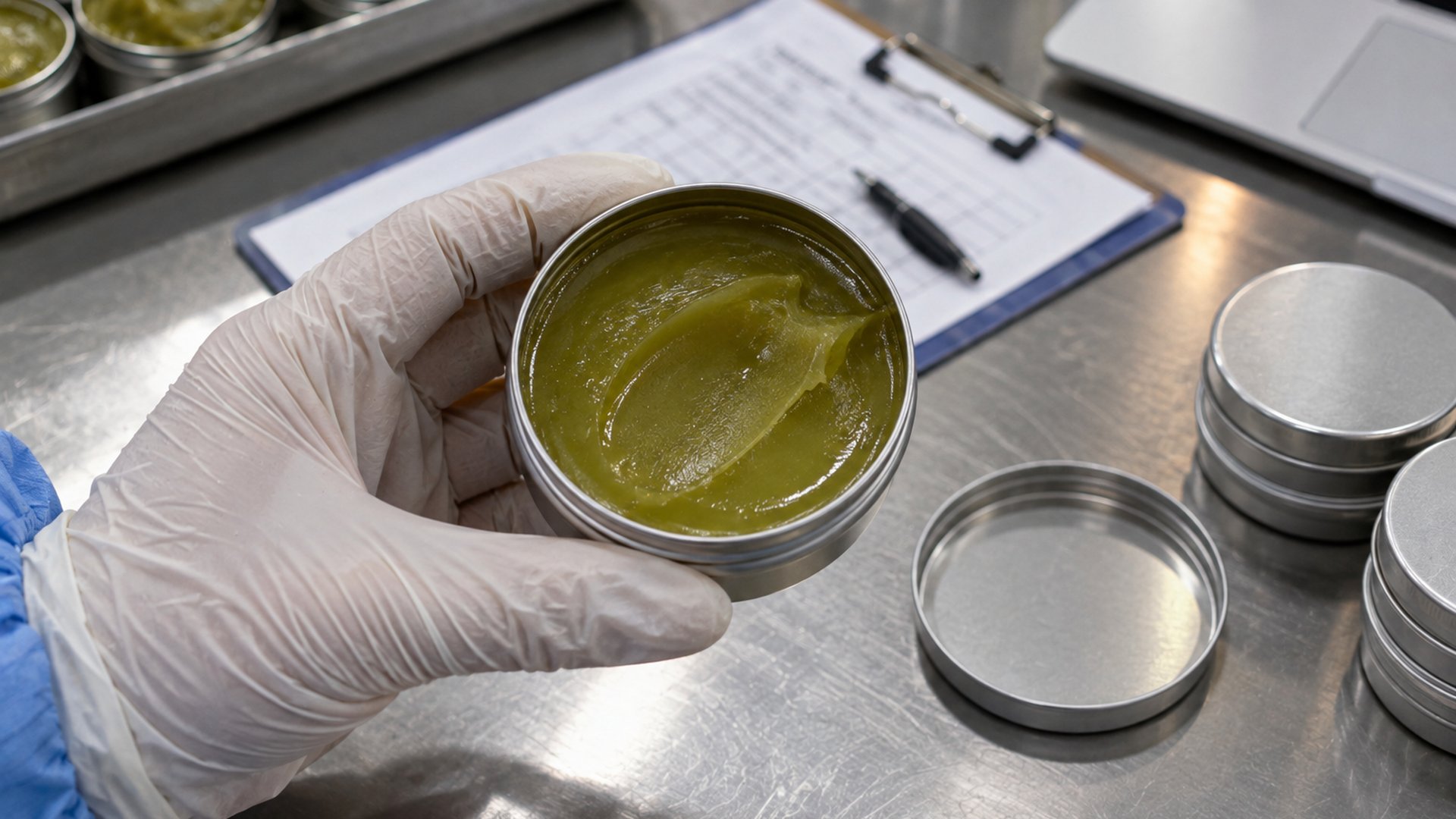
We asked the buyer to confirm the retail placement before approving the most expensive format.
Pharmacy, Wellness, and Online Channels Do Not Display the Same Way
The pharmacy channel created the most demanding labeling discussion.
A 30 g Mugwort Ointment jar might fit comfortably on a shelf, but a small curved label offers limited room for ingredients, directions, warnings, batch identification, and other information required by the destination market.
A folding carton can provide more printable surface, although it does not remove any requirement for information that must appear on the immediate container.
For the illustrative carton, we proposed external dimensions of approximately 48 × 48 × 55 mm, subject to the actual jar drawing and closure clearance.
The buyer also needed to confirm the product's regulatory classification and permitted claims. A wellness-oriented ointment should not be presented with unsupported medical promises simply because it is sold through a pharmacy.
The wellness channel presented a different problem.
The buyer wanted a counter display holding twelve cartons, arranged in three rows of four. That layout required a display footprint of approximately 210 × 165 mm after allowing for board thickness and handling clearance.
Those dimensions were preliminary design assumptions, not approved retailer specifications.
A display that looks attractive in a design rendering may exceed the retailer's available counter space. Before ordering printed display trays, the brand should obtain the retailer's actual footprint and height limits.
Online distribution was more straightforward.
The jar and carton needed to withstand ordinary parcel handling when combined with suitable shipping protection. The retail carton itself should not be treated as a substitute for an appropriately designed shipping pack.
We also checked whether the carton added dimensional weight without improving the customer experience.
For this buyer scenario, the channels did not justify three separate primary packaging designs.
They justified one consistent jar, with secondary packaging selected according to actual retail requirements.
Where the Buyer Nearly Over-Engineered the Packaging
The first unnecessary feature was a rigid presentation box.
It looked impressive in the concept images, but it was poorly matched to a relatively small, frequently purchased ointment. It also occupied more display and shipping space than the product required.
The second was an elaborate printing specification.
The initial artwork concept included six printed colors, metallic finishing, and selective surface effects. For the intended launch, a four-color folding carton offered sufficient design flexibility without introducing every decorative process.
A specialty finish can be justified when it supports a defined brand requirement. It should not be added simply because the printer offers it.
The third was a dedicated display tray for every sales channel.
That would have created unnecessary component inventory, additional assembly instructions, and more packaging revisions to control.
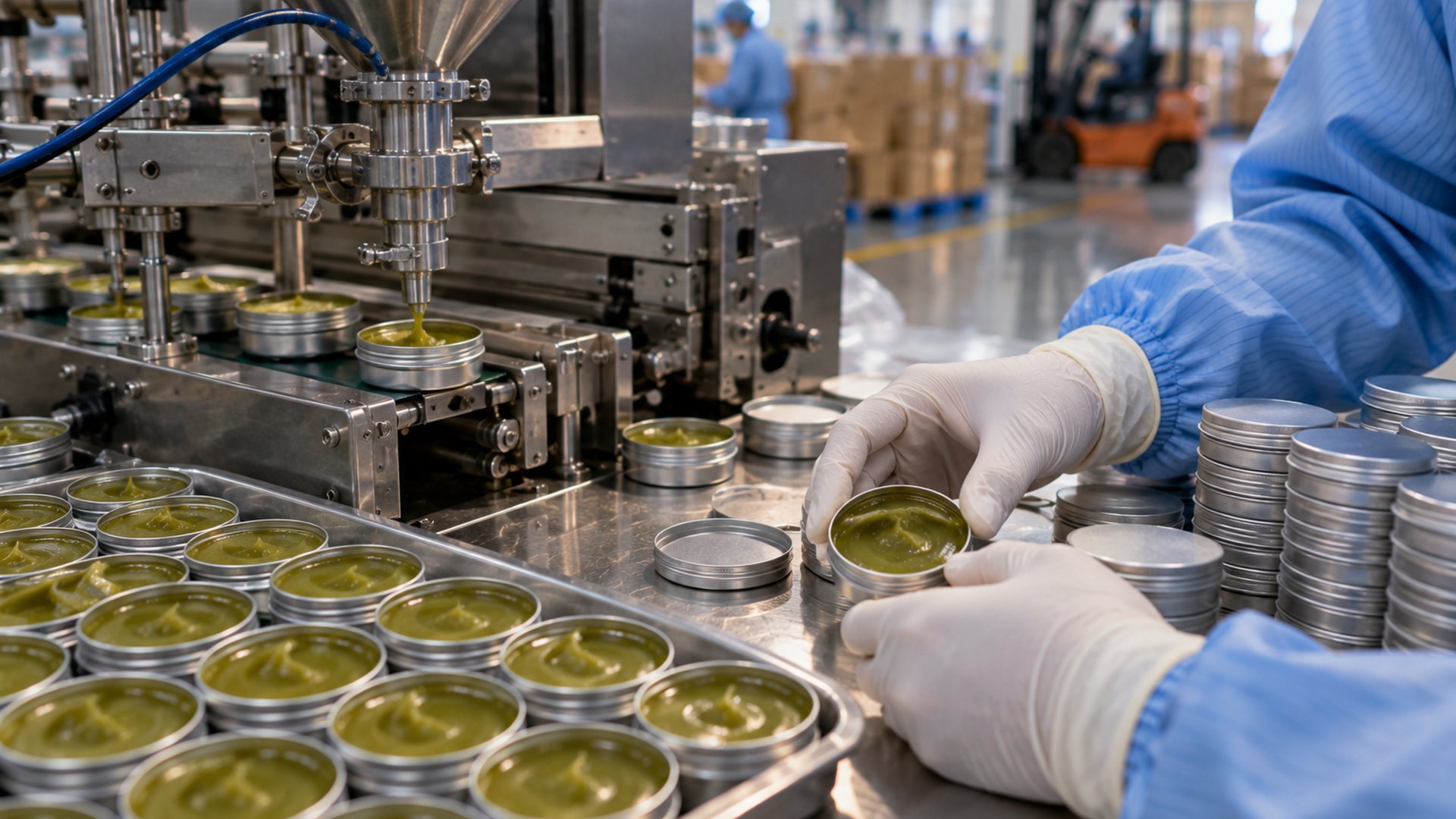
We reduced the proposed system to a common jar and closure, a standard folding carton for channels that needed it, and an optional counter display ordered only against confirmed retail placement.
The packaging artwork still required careful control.
The ingredient declaration, net contents, directions, warnings, responsible business information, and other mandatory details would need review against the intended destination market.
A mugwort ointment custom packaging supplier can support artwork preparation and production, but the final labeling obligations depend on the product classification, formulation, claims, and jurisdiction.
The buyer should not approve printing until those details are resolved.
This was a commercial packaging exercise, not a substitute for regulatory review or packaging compatibility assessment.
One Launch Format, With a Clear Reason to Expand
The most useful decision in the project was to stop treating every potential channel as an immediate packaging requirement.
For the representative launch, we recommended a labeled 30 g jar inside a conventional folding carton as the primary retail format, assuming the buyer confirmed that its target retailers required or preferred that presentation.
The counter display would remain optional until a retailer provided an approved display specification and a committed placement quantity.
That approach gave the buyer a consistent shelf appearance while avoiding a separate display-production commitment before demand was established.
The carton also provided a practical surface for approved product information, although the container label still needed to satisfy applicable requirements.
We would keep the jar, closure, and core artwork architecture consistent across channels. Channel-specific changes would be limited to documented secondary-packaging requirements.
The project decision can be summarized in three commercial tests.
First, does the packaging physically fit the intended retail fixture?
Second, does it carry the required information clearly and compliantly?
Third, does the additional packaging cost produce a benefit that the retailer or buyer can identify?
If a feature fails all three tests, it should not survive the quotation review.
The modeled folding-carton premium of $0.07 per unit was therefore easier to justify than the additional counter-display allocation. The carton supported the selected retail presentation; the display had no confirmed placement yet.
The illustrative project outcome was a simplified approved-for-quotation packaging direction, not a claim of completed production or measured sales performance.
For a mugwort ointment custom packaging supplier, this is where practical packaging work adds value: translating shelf requirements into a manufacturable specification without turning every design preference into another component.
The lesson for the buyer is equally direct. Choose the format for the channel that will actually launch, confirm the display dimensions, approve the required labeling, and price optional formats separately.
A good retail package earns its cost on the shelf. Anything beyond that needs a specific commercial reason.
CATEGORIES
LATEST NEWS
- Sinew-Bone Pain-Bi Patch Private Label Manufacturer Supply Agreements
- What Hand Mask Custom Packaging Supplier Quotes Overlook
- Kids Herbal Foot Patch Contract Manufacturer: Safety Specifications First
- Mugwort Steam Eye Mask Private Label Manufacturer Readiness Check
- Mugwort Essential Oil Custom Formula Supplier: Formulation Approval Milestones
CONTACT US
QQ: 396269538
Phone: 17796669065
Tel: 17796669065
Email: 396269538
Add: Room 001, 1st Floor, Building 1, Zhengzhou Hangmei International Smart City, Intersection of S102 and Nanquan Road, Xuedian Town, Xinzheng City, Zhengzhou, Henan Province, China