Industry news
How Are Health Patches Made? A Step-by-Step Manufacturing Guide
Industry news 2026-08-29 13:15:58 94 views admin
Short Answer
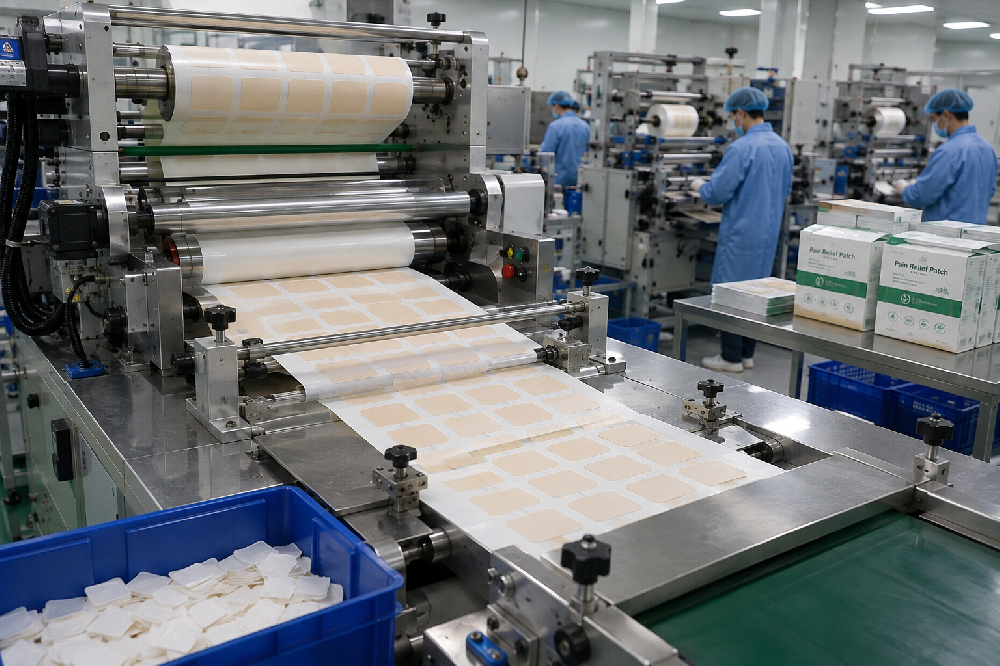
Health patches are manufactured through a series of controlled production steps that may include raw material preparation, formulation or material mixing, coating, drying, lamination, cutting, packaging and quality inspection.
The exact process depends on the type of patch.
A hydrocolloid acne patch, herbal heat patch, cooling patch and topical pain relief patch may use different materials and manufacturing technologies, even though they share a similar adhesive format.
What Is the Basic Structure of a Health Patch?
Before looking at the manufacturing process, it helps to understand the basic structure.
Many adhesive patches contain several layers:
-
Backing layer
-
Functional or active layer
-
Adhesive layer
-
Release liner
Not every patch uses the same structure.
For example, a hydrocolloid patch has different material requirements from a heat-generating patch.
The manufacturer therefore starts by selecting materials according to the product specification.
Step 1: Raw Material Preparation
The first stage is preparing the materials needed for production.
Depending on the product, these may include:
-
Non-woven fabric
-
Polymer film
-
Adhesive materials
-
Hydrocolloid materials
-
Functional ingredients
-
Herbal ingredients
-
Release liners
-
Packaging materials
Raw materials should be identified and inspected before entering production.
Material consistency is important because changes in raw materials can affect adhesion, flexibility, appearance and overall product performance.
Step 2: Formulation or Material Mixing
For products containing active or functional ingredients, the next stage may involve formulation and mixing.
The exact procedure depends on the product.
For example, a topical patch may require active ingredients to be evenly distributed throughout a matrix or adhesive layer.
A heat patch uses a completely different mechanism and may involve materials designed to generate heat through a controlled reaction.
This is one reason why "health patch manufacturing" is not a single manufacturing process.
Different product categories require different technical processes.
Step 3: Coating
After the functional material has been prepared, it may be coated onto a backing or carrier material.
Coating needs to be controlled carefully.
Important factors can include:
-
Coating weight
-
Uniformity
-
Thickness
-
Surface condition
-
Drying requirements
An uneven coating can affect product consistency.
For private label products, coating specifications should be included in the product's technical documentation.
Step 4: Drying
Some coating processes require controlled drying.
Drying removes moisture or solvent from the coated material and prepares the layer for subsequent processing.
The conditions depend on the formulation and material.
Temperature, time and airflow may need to be controlled to maintain the intended characteristics of the product.
Not every health patch uses the same drying process. Some products use different material systems that require different processing conditions.
Step 5: Lamination
Lamination combines different layers into a finished patch structure.
For example, a production line may combine:
Backing material + functional layer + adhesive + release liner
The objective is to create a stable multilayer structure that can be cut and packaged.
Lamination quality can affect:
-
Layer adhesion
-
Flexibility
-
Appearance
-
Product durability
The correct combination depends on the patch design.
Step 6: Cutting and Die-Cutting
Once the laminated material is ready, it is converted into individual patches.
Manufacturers can use cutting or die-cutting equipment to create different shapes.
Common designs include:
-
Rectangles
-
Squares
-
Circles
-
Oval patches
-
Anatomical shapes
-
Custom brand shapes
For OEM products, the patch shape can be designed around the intended application area and packaging format.
Custom shapes may require tooling, which should be discussed before production.
Step 7: Individual Packaging
After cutting, individual patches are normally packaged.
Packaging protects the product from environmental exposure and makes it easier to store, transport and use.
Common packaging formats include:
-
Individual foil pouches
-
Sachets
-
Plastic protective packs
-
Boxes containing multiple individual units
For private label brands, packaging can also be customized with:
-
Brand logo
-
Product name
-
Instructions
-
Ingredients
-
Barcode
-
Batch information
-
Market-specific labeling
Packaging requirements should be finalized before mass production.
Step 8: Quality Inspection
Quality inspection is performed throughout the production process rather than only at the end.
Depending on the product, inspections may cover:
Appearance
The finished patch should meet the agreed appearance and dimensional specifications.
Adhesion
The adhesive should meet the product's defined performance requirements.
Dimensions
Patch size and shape should remain within the approved specifications.
Packaging
Individual packaging should be properly sealed and correctly labeled.
Batch Information
Production records and batch identification should support traceability.
For regulated products, the exact inspection and testing requirements depend on the product classification and target market.
Step 9: Finished Product Storage
After inspection, finished products should be stored under appropriate conditions before shipment.
Storage requirements depend on the product and packaging.
Important considerations can include:
-
Temperature
-
Humidity
-
Light exposure
-
Packaging integrity
-
Shelf-life requirements
A well-designed storage system helps maintain product consistency before delivery.
Does Every Health Patch Use the Same Manufacturing Process?
No.
This is one of the most important points for buyers.
For example:
Hydrocolloid patch
Usually focuses on hydrocolloid material preparation, coating or forming, lamination and precision cutting.
Herbal heat patch
May require a heat-generating formulation and controlled packaging.
Cooling patch
May use a gel or hydrogel-based system designed to provide a cooling sensation.
Topical pain relief patch
May involve an active ingredient incorporated into a suitable adhesive or matrix system.
Therefore, buyers should select a manufacturer based on the specific technology required for their product.
What Equipment Is Used in Patch Manufacturing?
A patch production facility may use different equipment depending on the product.
Typical equipment can include:
-
Mixing equipment
-
Coating machines
-
Drying systems
-
Laminating machines
-
Slitting machines
-
Die-cutting machines
-
Packaging machines
-
Inspection equipment
The production line should be selected according to the product rather than simply maximizing machine count.
Why Manufacturing Process Matters to Private Label Brands
For a private label brand, understanding the manufacturing process can make supplier communication much easier.
Instead of simply asking:
"How much does this patch cost?"
a buyer can provide more useful information:
-
Product type
-
Patch size
-
Materials
-
Formula
-
Adhesive requirements
-
Packaging format
-
Target market
-
Estimated order quantity
The manufacturer can then provide a more accurate quotation and production proposal.
From Sample to Mass Production
A typical OEM development process can follow this structure:
Product brief → Sample development → Sample evaluation → Specification confirmation → Packaging artwork → Pilot production → Quality inspection → Mass production → Final packaging → Shipment
The exact process varies by manufacturer and product.
For a new brand, the sample stage is particularly important because it allows the buyer to identify problems before committing to a larger production order.
Conclusion
Health patches are manufactured through a combination of material preparation, formulation, coating, drying, lamination, cutting, packaging and quality inspection.
However, there is no universal production process for every health patch.
The manufacturing technology depends on whether the product is a pain relief patch, hydrocolloid patch, herbal heat patch, cooling patch or another specialized format.
For brands developing private label products, understanding the manufacturing process makes it easier to communicate specifications, compare suppliers and evaluate production quality.
Hanmeng Bio-Tech currently presents itself as a health patch OEM/ODM manufacturer and lists multiple patch categories on its website, making the manufacturing-process topic a natural supporting cluster for its existing product and OEM content.
FAQ
How long does it take to manufacture health patches?
Production time depends on the product, raw materials, packaging and order quantity. Sample development and artwork approval should also be included when estimating the total project timeline.
What materials are used to make health patches?
Common materials include non-woven fabrics, polymer films, adhesives, hydrocolloid materials, functional ingredients and release liners.
Can health patches be custom shaped?
Yes. Many manufacturers can produce custom shapes through die-cutting, although custom tooling may be required.
Can the packaging be customized?
Yes. Private label manufacturers can typically customize pouches, boxes, labels and other packaging according to the product and market requirements.
Are all health patches made using coating machines?
No. The manufacturing process depends on the patch type. Different products may require different forming, mixing, coating, laminating or converting processes.
What should I provide to a manufacturer before requesting a quotation?
Provide the product type, dimensions, materials or formula if available, packaging requirements, target market and estimated order quantity.
Recommended Internal Links:
-
Health Patch Manufacturer
-
Pain Relief Patch
-
Herbal Heat Patch
-
Hydrocolloid Pimple Patch
-
Cooling Patch
-
OEM / ODM Services
-
Quality Control
-
Contact Us
Suggested Image Filename: health-patch-manufacturing-process.jpg
Suggested Image ALT: Health patch manufacturing process with coating and cutting equipment
Suggested Image Caption: Health patch materials moving through a coating and converting production line.
CATEGORIES
LATEST NEWS
- Sinew-Bone Pain-Bi Patch Private Label Manufacturer Supply Agreements
- What Hand Mask Custom Packaging Supplier Quotes Overlook
- Kids Herbal Foot Patch Contract Manufacturer: Safety Specifications First
- Mugwort Steam Eye Mask Private Label Manufacturer Readiness Check
- Mugwort Essential Oil Custom Formula Supplier: Formulation Approval Milestones
CONTACT US
QQ: 396269538
Phone: 17796669065
Tel: 17796669065
Email: 396269538
Add: Room 001, 1st Floor, Building 1, Zhengzhou Hangmei International Smart City, Intersection of S102 and Nanquan Road, Xuedian Town, Xinzheng City, Zhengzhou, Henan Province, China