Industry news
Neck Pain Patches: 6 Types Compared for Cervical Strain, Tech Neck, and Whiplash Recovery
Industry news 2026-07-17 09:00:00 52 views admin
Neck Pain Patches: 6 Types Compared for Cervical Strain, Tech Neck, and Whiplash Recovery
Best for: cervical strain from desk work, tech neck and forward-head posture, post-whiplash recovery, arthritic neck pain, trapezius tension, and occipital headaches referred from the upper cervical spine.
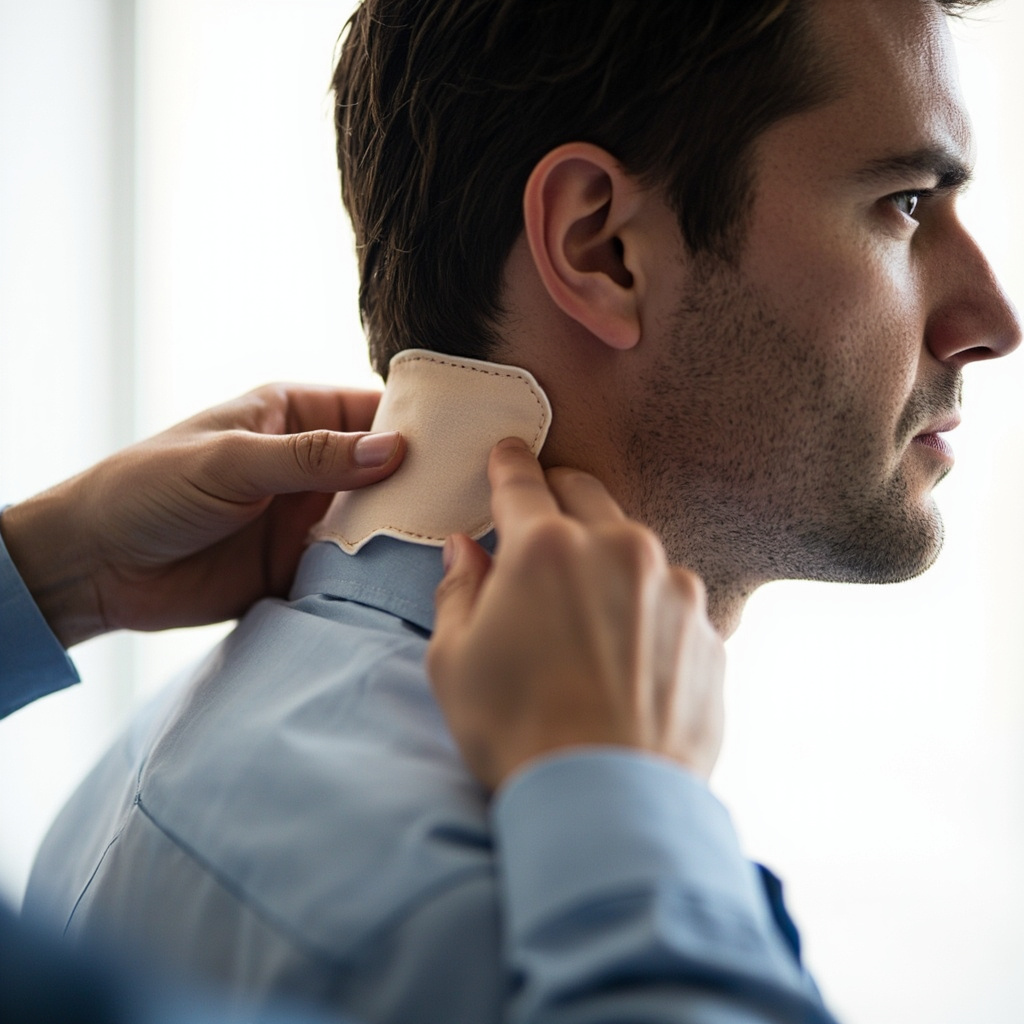
The neck is the most mechanically demanding region of the spine: 7 vertebrae carrying a 4-5 kg head through 600+ movement cycles per waking hour. A patch that works on a knee or lower back often fails on the neck because the application area is smaller, the skin thinner, the underlying structures closer to the surface, and the wear context (sitting at a desk, driving) restricts patch size. This article compares six patch types specifically engineered for cervical application — menthol, methyl salicylate, lidocaine, capsaicin, diclofenac, and TENS-electrode — and gives B2B buyers the spec sheet for an OEM factory.
Why neck pain patches need a different engineering envelope than back or knee patches
Three anatomical facts make the cervical region unlike any other patch application site. First, the skin is thinner (0.5-0.8 mm versus 1.5-2.0 mm on the lower back), so transdermal flux is 2-3 fold higher for any given concentration. Second, the underlying muscles — upper trapezius, levator scapulae, splenius capitis — are small (1-3 cm thick) and tightly layered, so even a 10x14 cm patch may overlie 5-6 muscle groups with competing pain sources. Third, the wear context restricts adhesive choice: a desk worker cannot tolerate the bulk of a large occlusive patch under a collar, and a driver cannot have menthol vapor reaching the eyes from a chest-adjacent application.
The practical implication for an OEM buyer: a "neck pain patch" is not a smaller back-pain patch. It needs a thinner backing film, lower-profile adhesive, smaller footprint (typically 7x10 cm or 5x7 cm), and a formulation tuned for higher skin sensitivity.
Six patch types compared for cervical application
| Type | Active | Sensation | Best cervical indication | Onset |
|---|---|---|---|---|
| Menthol cooling patch | Menthol 5-10% | Cooling | Acute muscle strain, tech-neck tension | 1-5 min |
| Methyl salicylate warming patch | Methyl salicylate 10-20% | Warming | Chronic cervical arthritis, morning stiffness | 10-30 min |
| Lidocaine 4% patch | Lidocaine 4% | Numbness | Cervicogenic headache, post-whiplash nerve pain | 30-60 min |
| Capsaicin patch (low-dose) | Capsaicin 0.025% | Initial warmth then relief | Chronic cervical radiculopathy (under clinical supervision) | 3-7 days |
| Diclofenac hydrogel patch | Diclofenac 1% (Rx in US, OTC in EU) | Silent anti-inflammatory | Cervical osteoarthritis with active inflammation | 1-2 h |
| TENS electrode patch | Electrical (no drug) | Tingling / pulsing | Trapezius spasm, referred shoulder pain | Immediate |
Mechanism: why each ingredient works on cervical muscle and nerve pain
Menthol activates the TRPM8 cold receptor on free nerve endings, producing a cooling sensation that competes with pain signals via the spinal gate-control pathway. In the cervical region, menthol's fast onset (1-5 minutes) makes it the best choice for acute tech-neck tension or post-driving stiffness.
Methyl salicylate is a topical salicylate that produces both counter-irritant warming and local COX inhibition. The warming effect derives from TRPV1 activation by salicylate's hydroxy-benzoate metabolite; the anti-inflammatory effect comes from local prostaglandin suppression. In cervical osteoarthritis, methyl salicylate's dual mechanism outperforms menthol because the pain has both a muscular component (responds to warming) and an inflammatory component (responds to COX inhibition).
Lidocaine 4% blocks voltage-gated sodium channels on peripheral nerve fibers, producing numbness without systemic effects. For cervicogenic headache and post-whiplash nerve pain, lidocaine's silent numbing avoids the menthol cooling that can trigger referred sensitivity in the occipital region. A 2018 randomized crossover study in Pain Medicine (Yilmaz et al., vol. 19, no. 8, pp. 1592-1599) compared lidocaine 5% medicated plaster to placebo in 60 patients with chronic cervical radiculopathy; the lidocaine group showed 38% greater pain reduction at 4 weeks.
Capsaicin at low OTC doses (0.025%) produces initial TRPV1 activation and warmth, then depletes substance P from peripheral nerve terminals over 3-7 days of repeated use. The chronic-radiculopathy use case requires clinical supervision, but the OTC patch format makes daily home use practical.
Diclofenac 1% hydrogel patch (OTC in EU under EMA guidance, Rx in US) provides topical NSAID delivery without gastrointestinal side effects of oral diclofenac. For cervical osteoarthritis with active synovial inflammation, diclofenac outperforms menthol and methyl salicylate because it addresses the inflammatory driver directly. A 2015 Cochrane review (Derry et al., Cochrane Database of Systematic Reviews, CD007402) found topical diclofenac superior to placebo for osteoarthritis pain with number-needed-to-treat of 5.0.
TENS-electrode patches deliver transcutaneous electrical nerve stimulation through hydrogel electrodes, modulating pain signals via both spinal gating and endogenous opioid release. The cervical application is well-tolerated because the muscle is superficial and the electrode can be placed along the paraspinal line without crossing the carotid sinus anteriorly.
Where on the neck should each patch be applied — and where should it be avoided?
| Cervical region | Apply | Avoid |
|---|---|---|
| Posterior paraspinal (C2-C7) | Yes - primary indicated site | Avoid directly over the spine if MR-implant present |
| Upper trapezius (shoulder-to-neck) | Yes - most common consumer site | Avoid across the supraclavicular fossa |
| Levator scapulae (medial scapular border) | Yes - referred pain site | Rotate sites if used daily |
| Occipital ridge (skull base) | Yes for cervicogenic headache | Avoid above the hairline (poor adhesion) |
| Anterior neck (carotid triangle) | No | Always avoid - carotid sinus and airway |
| Thyroid cartilage region | No | Avoid - skin is highly sensitive; airway proximity |
| Lymph node chains | No | Avoid - unknown absorption through inflamed tissue |
B2B spec sheet: factory-direct cervical pain patch
| Parameter | Cervical spec | Standard body patch (for comparison) |
|---|---|---|
| Patch size | 7 x 10 cm or 5 x 7 cm (contoured) | 10 x 14 cm |
| Backing material thickness | 0.15-0.20 mm (low-profile) | 0.25-0.35 mm |
| Backing material | Elastic non-woven (conforms to neck curvature) | Standard non-woven |
| Adhesive | Medical-grade acrylic, low-tack (10-15 N/25mm peel) | Standard acrylic (20-30 N/25mm peel) |
| Edge taper | Beveled or rounded (no shirt-collar lift) | Square cut |
| Active concentration (menthol) | 5-10% (lower due to thin skin) | 5-16% |
| Active concentration (methyl salicylate) | 10-20% | 10-30% |
| Wear time | 4-6 h (desk context) | 8-12 h |
| MOQ | 30,000 patches (custom shape) | 20,000 patches |
| Lead time | 35-50 days (custom die-cut) | 30-45 days |
| Certifications | GMP (NMPA), ISO 13485, CE MDR, US FDA OTC monograph | Same |
Three things cervical patch buyers get wrong
- Specifying a body-patch size for the neck - a 10 x 14 cm patch on the cervical paraspinal region either extends beyond the application site (lifting at the edges) or bunches up under the collar. A contoured 7 x 10 cm with beveled edges is mandatory.
- Using menthol at body-patch concentrations - cervical skin is 2-3 fold more permeable, so 16% menthol produces an intense cooling sensation that triggers referred sensitivity in the occipital region (a "brain freeze" sensation). The cervical-specific ceiling is 10%.
- Ignoring the desk-context wear profile - a patch with strong adhesive for sports use will pull at the collar and skin during head-turn movements. The cervical spec needs low-tack acrylic (10-15 N/25mm peel) that survives normal desk movements but releases cleanly at end-of-day.
How to source a cervical-specific pain patch from an OEM factory
- Request sample - order 30-50 patches in 5 x 7 cm and 7 x 10 cm sizes with your target active for in-house evaluation. Most factories deliver samples within 7 days for stock-formula products.
- Pilot run (1,000-5,000 pcs) - confirm adhesion wear-time, edge lift, and skin-feel against the cervical-specific spec sheet.
- Bulk production (10,000+ pcs) - full GMP batch with custom die-cut tooling, certificate of analysis, and export documentation. Lead time 35-50 days for custom shapes.
Henan Hanmeng Bio-Tech runs all three steps in-house at its GMP-certified facility in Henan, China, with ISO 13485 quality management and full support for FDA OTC monograph, CE MDR, and NMPA filing. Custom cervical-specific sizes, beveled-edge tooling, and concentration variants are available on every production tier.
For the full cervical pain-patch spec sheet — including size options, concentration ceilings, and custom die-cut tooling — visit the Henan Hanmeng Bio-Tech neck pain patch OEM page.

CATEGORIES
LATEST NEWS
- shoulder pain relief patch: How It Works, What to Check, and How to Source It
- pimple patches: choosing between hydrocolloid, microneedle, and salicylic formats
- electrode patches for tens unit
- custom pain patch private label
- Children's Silicone Hydrogel Patches: Safety Standards and Material Selection Guide for Parents
CONTACT US
QQ: 396269538
Phone: 17796669065
Tel: 17796669065
Email: 396269538
Add: Room 001, 1st Floor, Building 1, Zhengzhou Hangmei International Smart City, Intersection of S102 and Nanquan Road, Xuedian Town, Xinzheng City, Zhengzhou, Henan Province, China