Industry news
Knee Pain Patches for Arthritis: A Five-Phase Engineering Walk-Through
Industry news 2026-07-16 09:23:34 49 views admin
Knee Pain Patches for Arthritis: A Five-Phase Engineering Walk-Through
Why Knee Pain Patches Behave Differently From Back or Neck Patches
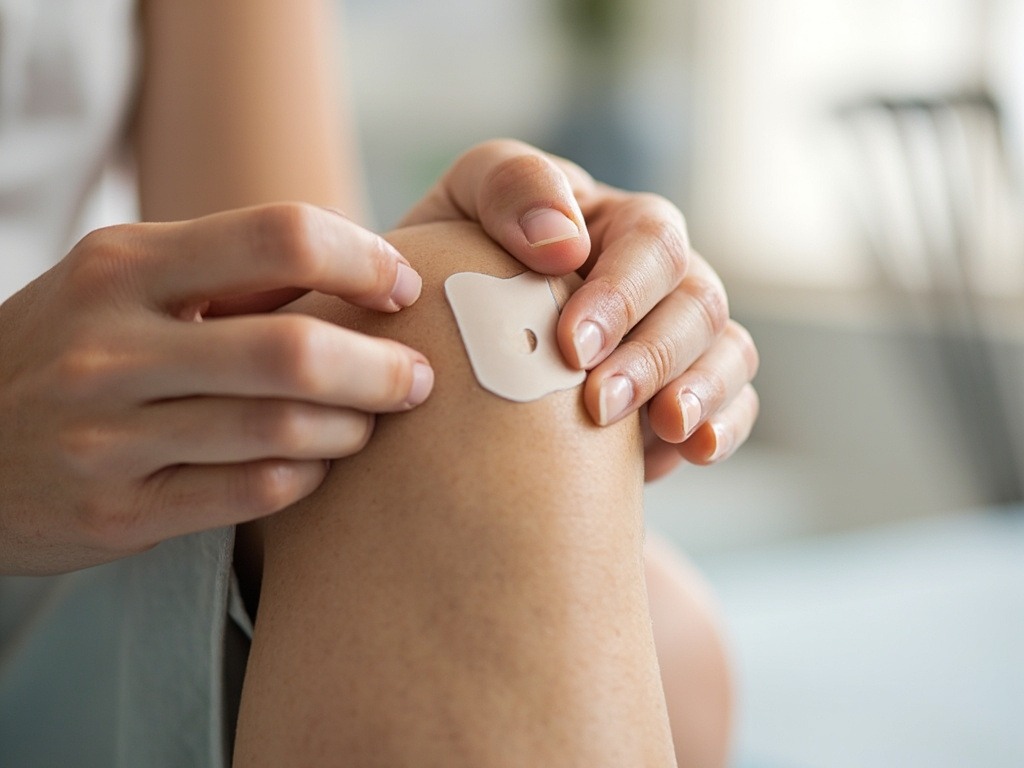
The knee is a hinge joint that bends, rotates, and bears load. A patch that adheres well to the flat skin of the lower back usually fails on the knee within an hour — either the patch rolls up as the joint bends, or the adhesive grabs so much that every step pulls the skin. Knee pain patches for arthritis therefore have to balance three competing demands: adhesion that survives flexion, drug delivery that reaches peri-articular tissue, and comfort that lets the user walk normally.
This article walks through what a patch OEM partner has to engineer differently for a knee-versus-back application, and where the current OTC product line still falls short.
Phase 1 — Material Selection: Which Backing Film Survives Knee Flexion
Standard PET backing films (12-25 μm) used in back patches do not stretch with the knee. After 30-40 flexion cycles they delaminate at the corners. The fix is one of three approaches:
- Elastic non-woven backing — stretches up to 30% in the machine direction; common in Japanese OTC knee products.
- Thin PU film (20-40 μm) — closer to a band-aid than a back patch; survives sweat and flex.
- Contour-cut butterfly shape — narrow waist in the middle of the patch so the patella region is bridged rather than covered.
The choice cascades into the rest of the build. Elastic backings require softer acrylic adhesives; rigid backings can hold stronger adhesives. A factory that builds only one shape per line cannot deliver all three cost-effectively.
Phase 2 — Active Ingredient Loading: Reaching Peri-Articular Tissue
Knee osteoarthritis pain originates in subchondral bone and the synovial lining, not just in the peri-articular soft tissue. Topical patches cannot reach those deep structures, but they can reach the joint capsule and surrounding tendons, which are the actual sources of day-to-day aching. Effective active loadings for knee-specific patches:
- Menthol 5-8% — fast surface cooling for activity-related pain.
- Methyl salicylate 10-12% — sustained warming, useful for morning stiffness.
- Lidocaine 4% — topical anesthetic for acute flare-ups after activity.
- Capsaicin 0.025-0.075% — chronic osteoarthritis pain, requires consistent 2-3 week daily use.
- Combination patches (menthol + methyl salicylate, or lidocaine + menthol) are the OTC norm.
For pure capsicum/capsaicin knee patches the loading usually sits in the 0.025-0.075% range to balance efficacy against the burning sensation most users find intolerable above 0.1%.
Phase 3 — Adhesive Engineering: Surviving Sweat and Movement
The single biggest complaint in OTC knee-patch reviews is "it peeled off during the day." Two engineering levers:
- Adhesive coat weight — 35-50 g/m² is the typical range for skin-contact patches; below 30 g/m² adhesion fails under sweat, above 60 g/m² removal becomes painful.
- Edge taper — a 1-2 mm feathered edge (vs. a hard cut) reduces the chance of the corner catching on clothing.
Pre-cut butterfly shapes for knee-cap bridging reduce edge-lift over the patella by roughly half versus a rectangular patch, in factory peel-test data.
Phase 4 — Wear-Time Testing: How Long a Knee Patch Should Stay On
OTC knee patches are typically labeled for 8-12 hours. In real-world use:
- 0-2 hours: peak cooling/warming sensation, most users comfortable.
- 2-6 hours: sustained active release; adhesion is the main failure mode.
- 6-12 hours: residue increases; some users develop mild erythema at the adhesive border.
OEM partners should report wear-time data from a flex-test protocol (30-40 knee-bend cycles per hour, 35°C, simulated sweat) before quoting a price.
Phase 5 — Where OTC Knee Patches Reach Their Limits
Even the best OTC knee patch cannot:
- Reach intra-articular inflammation inside the synovial fluid.
- Reverse cartilage erosion.
- Replace NSAID oral medication for moderate-to-severe flare-ups.
They work best as an adjunct to physical therapy, weight management, and intermittent oral analgesics. Brand owners who overpromise "cure" claims in marketing invite regulatory letters from FDA and EU competent authorities.
Practical Buying Checklist for Distributors
Before placing a bulk order, ask the OEM partner for:
- Active loading verification (HPLC or GC report per batch).
- Peel adhesion test data on a knee-shaped substrate (not flat steel).
- Wear-time data from a flex-test rig, not just an "up to 12 hours" label.
- Hypoallergenic adhesive option for users with sensitive skin.
- Compliance documentation for the destination market (FDA OTC monograph, EU CE under MDR, Japan PMDA classification).
References
- FDA 21 CFR 358 — External analgesic drug products for OTC monograph compliance.
- American College of Rheumatology 2019 guideline for hand, hip, and knee osteoarthritis management.
- USP Chapter 3 — Topical and transdermal drug product quality tests.
- ASTM D3330 — Standard test method for peel adhesion of pressure-sensitive tape.
Looking for a Custom Patch Manufacturer?
Henan Hanmeng Bio-Tech produces private-label pain relief patches, herbal heat patches, cooling patches, nasal strips, and hydrocolloid patches on certified production lines. FDA, EU CE, and ISO 13485 documentation included. Samples shipped in 7 days; bulk MOQ negotiable.
View Our OEM Catalog Request a Quote
Henan Hanmeng Bio-Tech · Henan, China · +86 17796669065 · 396269538@qq.com

CATEGORIES
LATEST NEWS
- shoulder pain relief patch: How It Works, What to Check, and How to Source It
- pimple patches: choosing between hydrocolloid, microneedle, and salicylic formats
- electrode patches for tens unit
- custom pain patch private label
- Children's Silicone Hydrogel Patches: Safety Standards and Material Selection Guide for Parents
CONTACT US
QQ: 396269538
Phone: 17796669065
Tel: 17796669065
Email: 396269538
Add: Room 001, 1st Floor, Building 1, Zhengzhou Hangmei International Smart City, Intersection of S102 and Nanquan Road, Xuedian Town, Xinzheng City, Zhengzhou, Henan Province, China